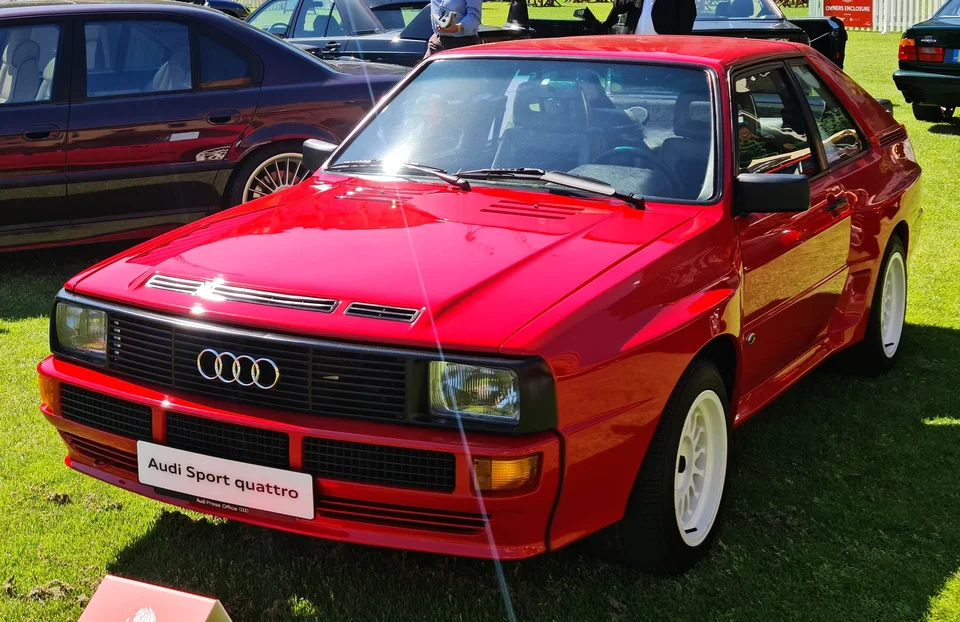
Audi Sport Quattro
Why 3.0: Audi cut 320mm out of the Ur-Quattro's wheelbase and fitted a 306-hp 20-valve turbo five to build a shorter, sharper Group B homologation special — 214 built, each one costing more than a Lamborghini Countach when new. The permanent-AWD idea the Ur-Quattro pioneered is even more central here.
Layout
Natural habitat
Ride comfort
Sound
The five-cylinder's odd firing order gives it an off-beat warble no four or six can imitate, and it is identifiable within a second. But the turbo smothers the top end and 6,700 rpm keeps it short — character rather than range, much like the 22B below it.
5-cylinder · turbocharged · 6,700 rpm redline · rated 7.2 / 10 for engine sound
Market value
Median asking price, good condition · €74k (1984) → €736k (2026), trending up · illustrative data
Child seats · ISOFIX
Built before ISOFIX existed, so there are no anchor points at all. A child seat here is a seatbelt installation, and the belt geometry of the period was not designed with one in mind.
Derived from production years and seating layout, not a per-car source. ISOFIX was standardised as ISO 13216 in 1997, required on new EU model types from 2011 and on all new EU cars from 2014.
The long version
The standard Ur-Quattro was already winning rallies, but Audi's engineers wanted a shorter car for faster direction changes on tight stages, so they cut 320mm out of the wheelbase, fitted a new 20-valve version of the turbocharged inline-five, and built much of the body in Kevlar and carbon-fiber composites to keep weight in check despite the extra bracing a shorter wheelbase demanded. The result cost over DM 200,000 in period — more than a Countach — for a car most buyers would never take anywhere near its rally-stage limits. Prices sat flat for years while people who wanted an old Audi bought a regular Ur-Quattro instead, then took off hard once the wider market connected the Sport Quattro's rarity and homologation pedigree to the broader Group B boom; a car worth under $500,000 a decade ago now regularly clears $700,000, and the works S1 E2 competition cars it enabled sell for multiples of that. It still gets driven more than the mid-engine Italian and French Group B cars in this batch, since AWD makes it dramatically more forgiving in the wet — but at this price, more capable than the others still just means trailered slightly less often.