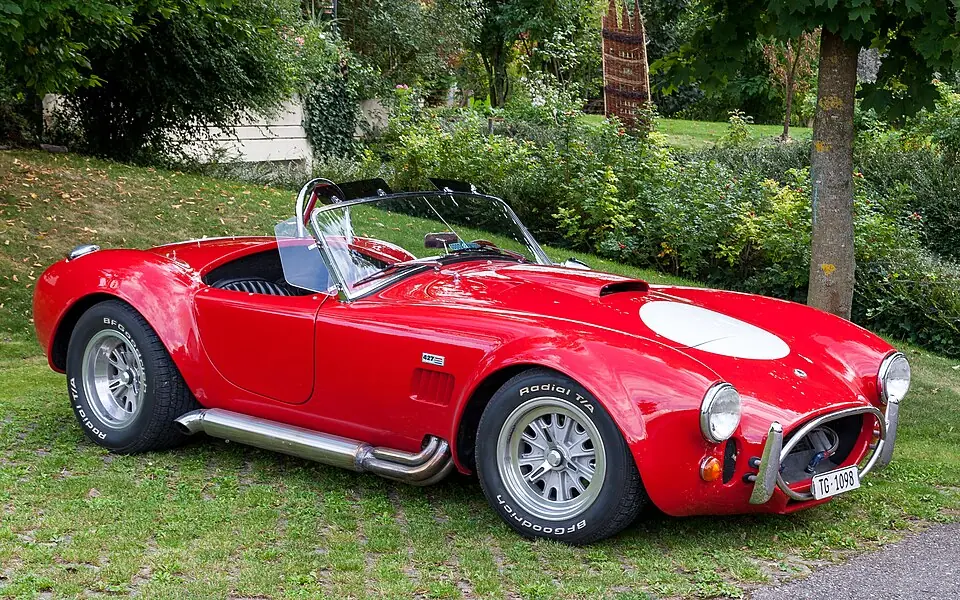
Shelby Cobra 427
Why 3.0: 425 horsepower, a live rear axle, skinny period tires and absolutely no electronic net under any of it — this is the most physically intimidating car on this shelf, full stop. Values for genuine 427s now run seven figures, but the Shelby American club culture around it is unusually active for a car this valuable, and vintage-racing survivors do still turn a wheel in anger.
Layout
Natural habitat
Ride comfort
Sound
Open side pipes under the doors of a car with no roof and no bodywork worth the name, fed by a 7.0-litre FE side-oiler. But it is a pushrod big block with the same agricultural edge that caps the Viper, and it runs out at 6,500 rpm. Volume rather than range.
8-cylinder · naturally aspirated · 6,500 rpm redline · rated 7.9 / 10 for engine sound
Market value
Median asking price, good condition · €6k (1965) → €1.2M (2026), trending up · illustrative data
Child seats · ISOFIX
Built before ISOFIX existed, so there are no anchor points at all. A child seat here is a seatbelt installation in the only passenger seat there is.
Derived from production years and seating layout, not a per-car source. ISOFIX was standardised as ISO 13216 in 1997, required on new EU model types from 2011 and on all new EU cars from 2014.
The long version
Carroll Shelby's answer to 'what if a British roadster carried a NASCAR-spec big-block' produced a car period testers genuinely struggled to control at the limit, and six decades later that reputation hasn't softened with familiarity — a 427 Cobra is still a physical, occasionally frightening thing to drive quickly. What keeps it off pure trailer-queen status is the Shelby community itself: unlike some of the more delicate Italian exotics on this list, Cobra owners have a long tradition of actually running these cars at tours and vintage races, treating the danger as part of the point rather than a reason to park it. The money involved — genuine 427s comfortably clear a million dollars now — still argues for caution most weekends.