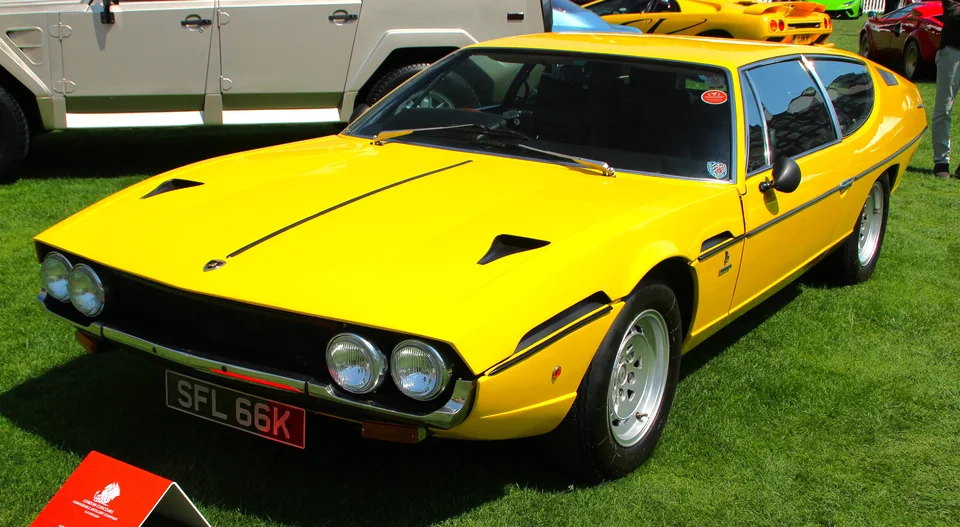
Lamborghini Espada
Why 6.0: Gandini drew a two-metre-wide glass-backed shooting brake with four genuine seats and put the Miura’s V12 in the nose of it. Around 1,200 were built — Lamborghini’s best-seller of the era — which is why it can still be used rather than curated, and it is the least Lamborghini-shaped Lamborghini ever sold.
Layout
Natural habitat
Ride comfort
Sound
The Bizzarrini quad-cam V12 on six Webers to 7,500 rpm produces an induction howl few engines match. But the Espada is the plush four-seater of the range, silenced accordingly, so you hear it through a layer of grand-touring insulation.
12-cylinder · naturally aspirated · 7,500 rpm redline · rated 8.4 / 10 for engine sound
Market value
Median asking price, good condition · €19k (1970) → €152k (2026), trending up · illustrative data
Child seats · ISOFIX
Built before ISOFIX existed, so there are no anchor points at all. A child seat here is a seatbelt installation, and the belt geometry of the period was not designed with one in mind.
Derived from production years and seating layout, not a per-car source. ISOFIX was standardised as ISO 13216 in 1997, required on new EU model types from 2011 and on all new EU cars from 2014.
The long version
Ferruccio Lamborghini’s stated ambition was to build better grand tourers than Ferrari, and the Espada is the purest expression of it: a long, low, extremely wide four-seater with the 3.9-litre V12 mounted conventionally at the front, a hatch over the luggage area, and enough rear headroom to carry adults across Europe. Bertone based it on the Marzal show car, and three series ran from 1968 to 1978, gaining power steering, then a Chrysler automatic option, then air conditioning that worked. It sold better than anything else Lamborghini made before the Countach, and that volume is what keeps it in reach today: a good Espada costs less than a mediocre Miura and can carry a family while doing it. Owners tend to keep them a long time, partly because there is no quick money in a car most people cannot identify, and partly because a V12 four-seater with a five-speed and no traction control is a specific taste that does not resell in a hurry.