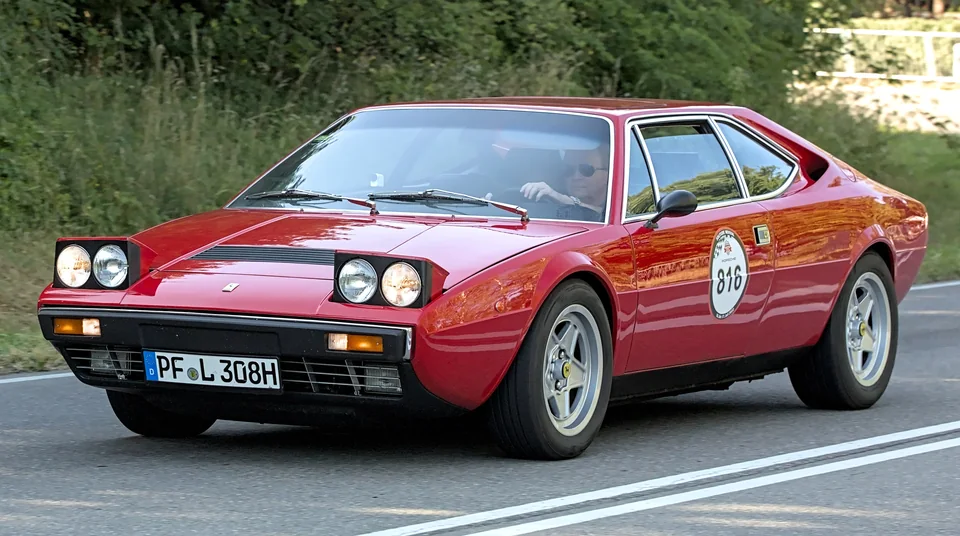
Ferrari 308 GT4
Why 6.0: Ferrari’s first production V8 and its first mid-engine 2+2, on a wheelbase 210 mm longer than the 308 GTB that followed it. It sold for years as the cheapest way into a mid-engine Ferrari because the market disliked the wedge and disliked the Dino badge, which left it in the hands of people who wanted the drive rather than the crest.
Layout
Natural habitat
Ride comfort
Sound
Four Weber carburettors feeding a 3.0 quad-cam V8 to 7,700 rpm, with the induction noise arriving over your shoulder from the transverse engine behind you. It falls short of the great screamers only on volume: a small, high-strung V8, not a big one.
8-cylinder · naturally aspirated · 7,700 rpm redline · rated 8.1 / 10 for engine sound
Market value
Median asking price, good condition · €21k (1975) → €78k (2026), trending up · illustrative data
Child seats · ISOFIX
Built before ISOFIX existed, so there are no anchor points at all. A child seat here is a seatbelt installation, and the belt geometry of the period was not designed with one in mind.
Derived from production years and seating layout, not a per-car source. ISOFIX was standardised as ISO 13216 in 1997, required on new EU model types from 2011 and on all new EU cars from 2014.
The long version
Bertone got the commission over Pininfarina and produced a folded-paper wedge in the middle of Ferrari’s most curvaceous era, then Ferrari sold it as a Dino rather than a Ferrari until May 1976. Two decisions, both reversible in hindsight, that cost the car thirty years of respect: for most of its life the GT4 was the entry point to Ferrari ownership at a price closer to a used Porsche than to the 308 GTB parked next to it. Around 2,800 were built. The engine is the same 2,926 cc V8 that went on to power the entire 308 and 328 line, the rear seats are real if short-legged, and the driving position and outward visibility are better than the prettier car’s. Prices have finally started climbing as the last people who remember the badge argument stop caring about it, but the ownership base is still made up of drivers who bought a usable classic Ferrari, not speculators who bought a shape.