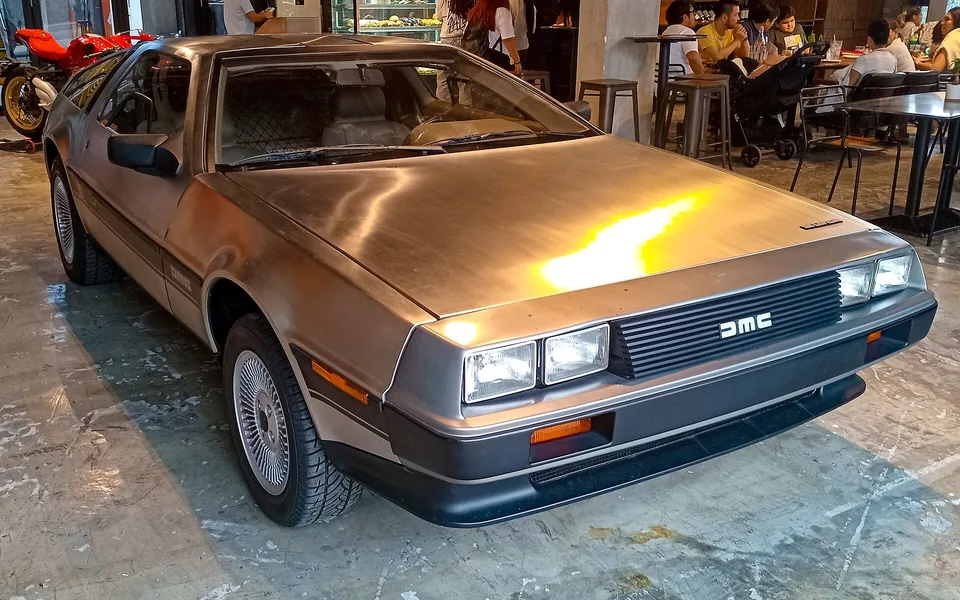
DeLorean DMC-12
Why 6.3: A film made it famous, but the ownership pattern behind it is real: a dense owners' club, a Texas company sitting on the original factory parts inventory, and cars cheap enough to use. DeLoreans get driven to events by people who bought them to keep. The driving is another matter entirely.
Layout
Natural habitat
Ride comfort
Sound
The PRV sits behind the rear axle with only a louvred glass panel between it and your ears, so you do hear a V6 rather than nothing at all. But it is a Volvo-Peugeot-Renault saloon engine choked to 130 hp by US emissions plumbing and finished at 5,500 rpm. A mid-engined silhouette wrapped around a family-saloon noise.
6-cylinder · naturally aspirated · 5,500 rpm redline · rated 3.8 / 10 for engine sound
Market value
Median asking price, good condition · €23k (1981) → €57k (2026), trending up · illustrative data
Child seats · ISOFIX
Built before ISOFIX existed, so there are no anchor points at all. A child seat here is a seatbelt installation in the only passenger seat there is.
Derived from production years and seating layout, not a per-car source. ISOFIX was standardised as ISO 13216 in 1997, required on new EU model types from 2011 and on all new EU cars from 2014.
The long version
Almost nothing about the DMC-12 worked as intended. John DeLorean's plan called for a mid-mounted Wankel and a chassis of his own; what got built was a Lotus-designed steel backbone with a Peugeot-Renault-Volvo V6 hung out behind the rear axle, wearing unpainted stainless steel panels over glassfibre because painted steel would have needed a paint shop the Belfast factory never had. US emissions equipment cut the PRV to 130 hp, which in a 1,288 kg car with 65 per cent of its mass at the back produces a 0–60 time around ten and a half seconds and handling that is safe rather than good. Roughly 9,000 were built before the company collapsed in 1982. And then the thing that should have destroyed the car's ownership base saved it. Back to the Future arrived in 1985, three years after the factory closed, and turned an orphaned failure into a permanent cultural object with a demand curve nothing else in this index has. That demand supports an industry: DeLorean Motor Company in Humble, Texas bought the remaining factory stock and has kept cars running for four decades, so parts availability for a car whose maker went bankrupt in 1982 is better than for plenty of surviving marques. The result is an unusually healthy pattern. Values have roughly tripled since 2010, but these are still owned by enthusiasts who take them to shows and cruise nights rather than by funds, and the mileage reflects that. It is not a good car. It is a well-kept one.