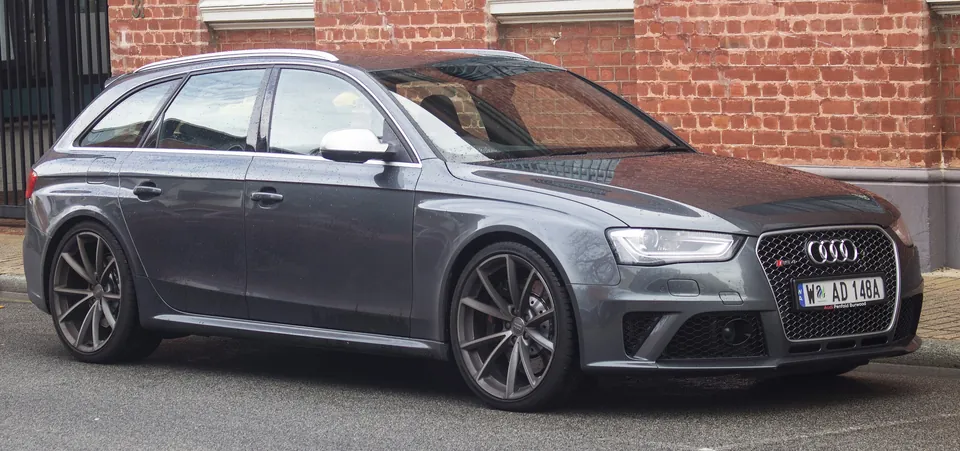
Audi RS4 Avant (B8)
Why 6.9: 450 PS from a 4.2-litre V8 that makes peak power at 8,250 rpm — no turbochargers, no electrification, and no successor: the B9 RS4 that replaced it dropped to a 2.9-litre twin-turbo V6. Estate only, and again never officially sold in North America.
Layout
Natural habitat
Ride comfort
Sound
The 4.2 FSI is Audi's last high-revving naturally aspirated V8, hardening into a real metallic wail by 8,250 rpm with a proper crack on the overrun. Audi's insulation keeps it more distant than an equivalent Italian V8, which stops it reaching the top tier.
8-cylinder · naturally aspirated · 8,250 rpm redline · rated 8.2 / 10 for engine sound
Market value
Median asking price, good condition · €71k (2013) → €53k (2026), trending down · illustrative data
Child seats · ISOFIX
Two ISOFIX positions on the outer rear seats, the outer pair being the ones the standard covers.
The rear anchors are the supported route — the manual points child seats there, and front-passenger ISOFIX is the exception rather than the rule. A belt-mounted seat up front needs the airbag off, and cars with a rear row don't always fit a deactivation switch, precisely because the rear seats exist.
Derived from production years and seating layout, not a per-car source. ISOFIX was standardised as ISO 13216 in 1997, required on new EU model types from 2011 and on all new EU cars from 2014.
The long version
The B8 RS4 is the end of a line and was understood as one at the time. Audi kept the 4.2-litre naturally aspirated FSI V8 from the B7 car, revised it for 450 PS, and geared it so that peak power arrives at 8,250 rpm — an engine that has to be worked, in a segment that was already turbocharging everything. Unlike the B7 it came only as an Avant, and only with the seven-speed S tronic dual-clutch; the manual was gone. The B8 platform had moved the front differential ahead of the clutch, pushing the engine back roughly 150 mm, which is why this is the first RS4 that does not feel permanently nose-led, and the optional sport differential does real work on the exit of a corner. It was not sold new in the United States, so the American conversation about it is entirely theoretical. Values fell to around half of list by 2020 and have been climbing since, for the obvious reason: Audi is not going to build another one.