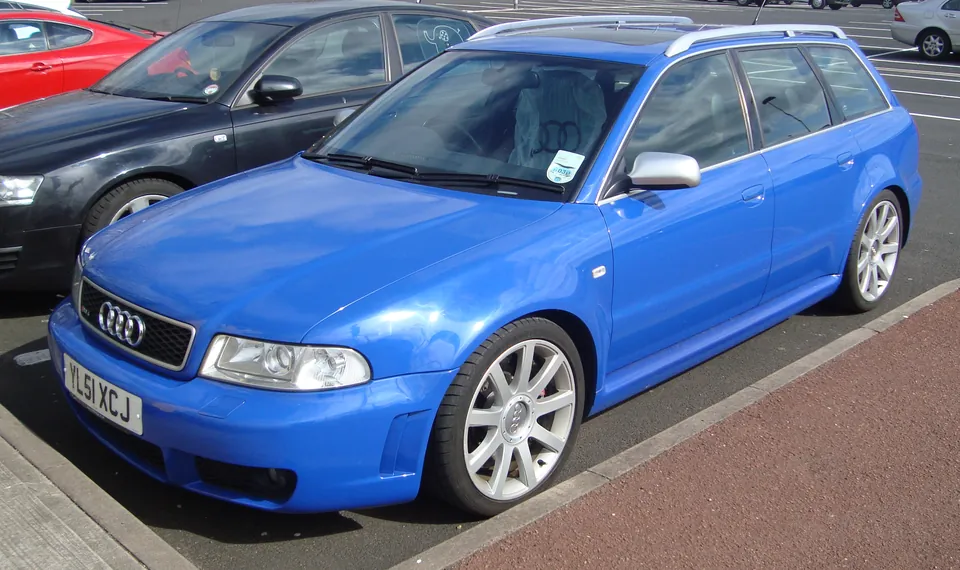
Audi RS4 Avant (B5)
Why 6.3: Cosworth Technology reworked the S4's 2.7 biturbo — new heads, bigger turbos, new intercoolers — for 380 PS, and quattro GmbH widened the arches to cover it. Six thousand and thirty built, estate only, manual only, and never sold new in the United States.
Layout
Natural habitat
Ride comfort
Sound
The charm of the 2.7 biturbo is entirely in the plumbing: spool from two small K04s and the flutter on lift that made this engine a tuner's favourite. The V6 underneath is muted by design and stops at 7,000 rpm with no crescendo at all.
6-cylinder · turbocharged · 7,000 rpm redline · rated 5.4 / 10 for engine sound
Market value
Median asking price, good condition · €58k (2001) → €57k (2026), trending down · illustrative data
Child seats · ISOFIX
ISOFIX was spreading through these years rather than fitted across the board — whether a given car has rear anchors depends on its year and market.
Children were expected in the back. Front-passenger ISOFIX effectively didn't exist in this era, and airbag deactivation was patchy — treat the front seat as a no unless a specific car proves otherwise.
Derived from production years and seating layout, not a per-car source. ISOFIX was standardised as ISO 13216 in 1997, required on new EU model types from 2011 and on all new EU cars from 2014.
The long version
Audi's RS line had gone quiet after the RS2 Avant, and the RS4 restarted it with the same formula: take the fast estate, hand it to an outside engine specialist, sell it in one body style for two years and stop. Cosworth Technology — by then owned by Audi's parent — reworked the S4's 2.7-litre biturbo V6 with new cylinder heads, larger turbochargers, bigger intercoolers and a new exhaust, taking it from 265 PS to 380 PS with 440 Nm spread from 2,500 to 6,000 rpm. quattro GmbH widened the body over the arches, fitted a six-speed manual and left the automatic off the options list entirely. 6,030 were built between 2000 and 2001 and none of them officially crossed the Atlantic; Audi's first US RS car was the B7 RS4 six years later. In Europe they went through a long, cheap middle age when a pair of failing turbos cost more than the car, and the survivors have come out the other side as a recognised classic — Nogaro Blue examples especially.