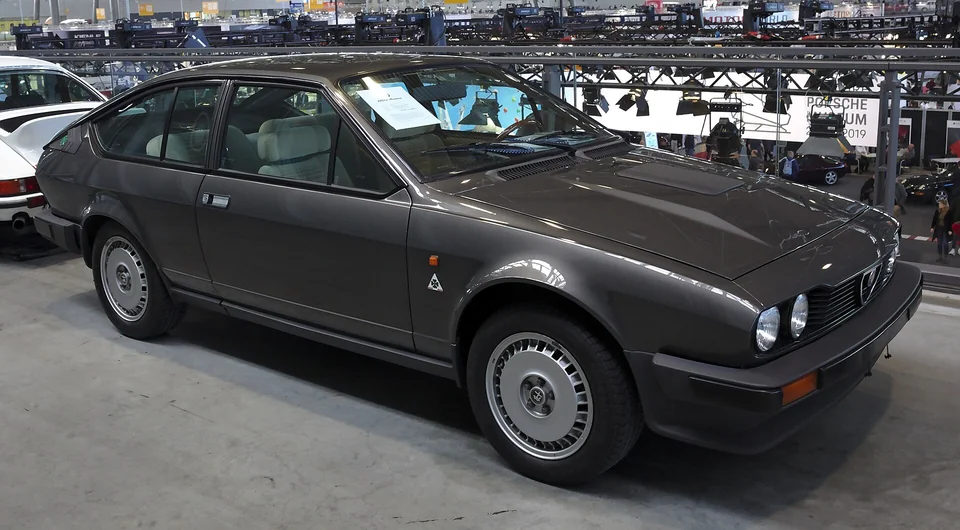
Alfa Romeo GTV6
Why 6.4: Alfa's 2.5-litre Busso V6 dropped into the Alfetta's transaxle chassis — clutch and five-speed at the rear axle, De Dion tube behind, and a bonnet bulge to clear the induction. One of the few cars in this batch Alfa genuinely did sell new in America, which is why the US survivor population is unusually healthy for an eighties Italian coupé.
Layout
Natural habitat
Ride comfort
Sound
The Busso V6 is a legend on note alone, and it earned that reputation with only 160 hp — proof this rating measures sound, not speed. It stops short of the top because 5,600 rpm limits how far the crescendo can run.
6-cylinder · naturally aspirated · 5,600 rpm redline · rated 8.3 / 10 for engine sound
Market value
Median asking price, good condition · €15k (1981) → €26k (2026), trending up · illustrative data
Child seats · ISOFIX
Built before ISOFIX existed, so there are no anchor points at all. A child seat here is a seatbelt installation, and the belt geometry of the period was not designed with one in mind.
Derived from production years and seating layout, not a per-car source. ISOFIX was standardised as ISO 13216 in 1997, required on new EU model types from 2011 and on all new EU cars from 2014.
The long version
The GTV6 is the Alfetta GTV finally given the six-cylinder engine the body always looked like it wanted, and the layout underneath is the interesting part. The engine sits at the front, but the clutch and five-speed gearbox live back at the rear axle joined by a torque tube, with a De Dion tube locating the rear wheels — a configuration that produces near-even weight distribution and steering that feels impossibly heavy at parking speeds and entirely natural above thirty. Alfa Romeo sold it in the United States as the GTV-6 from 1981 to 1986, so unlike almost everything else in this batch it is not an import-only proposition, and that is exactly why the Forbidden Fruit badge does not apply here however European the car feels to drive. Rust and the reputation of the Alfa dealer network held values flat for two decades; interest picked up sharply once the last generation of genuinely analogue Alfa coupés became a recognised category rather than just old cars. Most survivors are in enthusiast hands now and get used at weekends rather than daily, which is about right for a car whose timing belt demands respect and whose parts supply rewards patience.