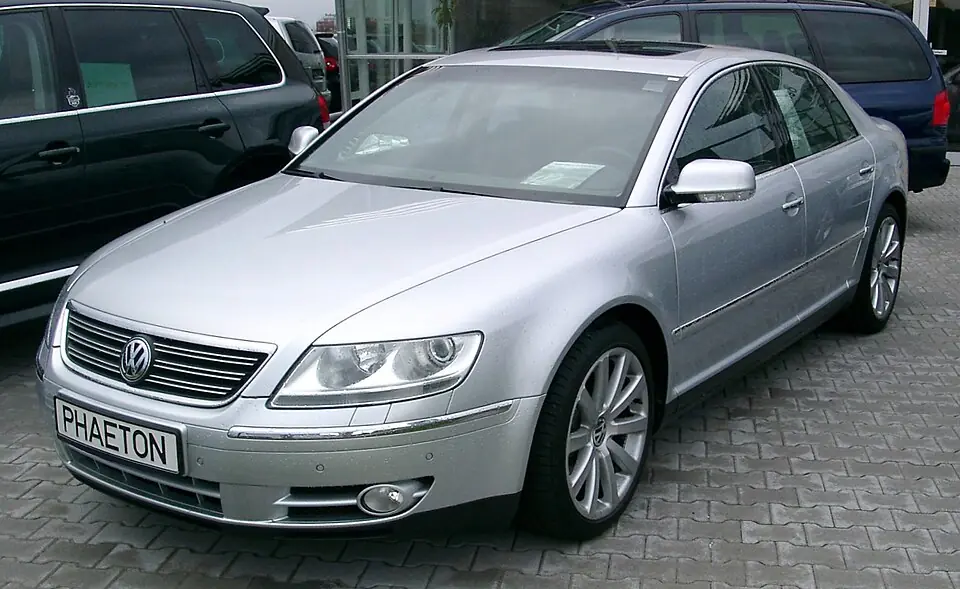
VW Phaeton W12
Why 7.5: A W12 built to rival S-Classes and 7 Series, sold at a price no luxury buyer wanted attached to a VW badge — and it cratered accordingly. What's left is a genuinely engineered flagship for the price of a used Golf, and the people who buy one at that price are keeping it, not flipping it.
Layout
Natural habitat
Ride comfort
Sound
Twelve cylinders running so smoothly that the only evidence is a distant hum under load. VW spent the development budget on double glazing and a sealed bulkhead specifically so you would not hear it. Rated on what actually reaches you, which is almost nothing.
12-cylinder · naturally aspirated · 6,500 rpm redline · rated 4.1 / 10 for engine sound
Market value
Median asking price, good condition · €88k (2004) → €14k (2026), trending down · illustrative data
Child seats · ISOFIX
ISOFIX anchors plus a top-tether point are fitted to both outer rear seats, standard.
The front passenger seat has no ISOFIX anchor; VW's own description of the Phaeton's child-safety kit only ever mentions the rear position.
A rearward-facing seat can still go up front on a belt mount — VW uses a key-turned lock at the airbag itself, rather than a simple dash switch, to disable it.
Volkswagen Newsroom (official Phaeton features page)
The long version
Volkswagen built this to prove it could out-engineer Mercedes and Audi on their own turf, shared underpinnings with the Bentley Continental, and priced it like a Volkswagen anyway — a combination that guaranteed commercial failure and, twenty years later, guarantees a remarkable used-car bargain. Depreciation did what marketing couldn't: it found the car an audience of people who wanted a genuine flagship and didn't care that the badge says VW, and that audience drives the thing daily instead of trailering it. Nobody flips a fifteen-thousand-dollar W12 sedan for profit; they just enjoy that it exists at all.