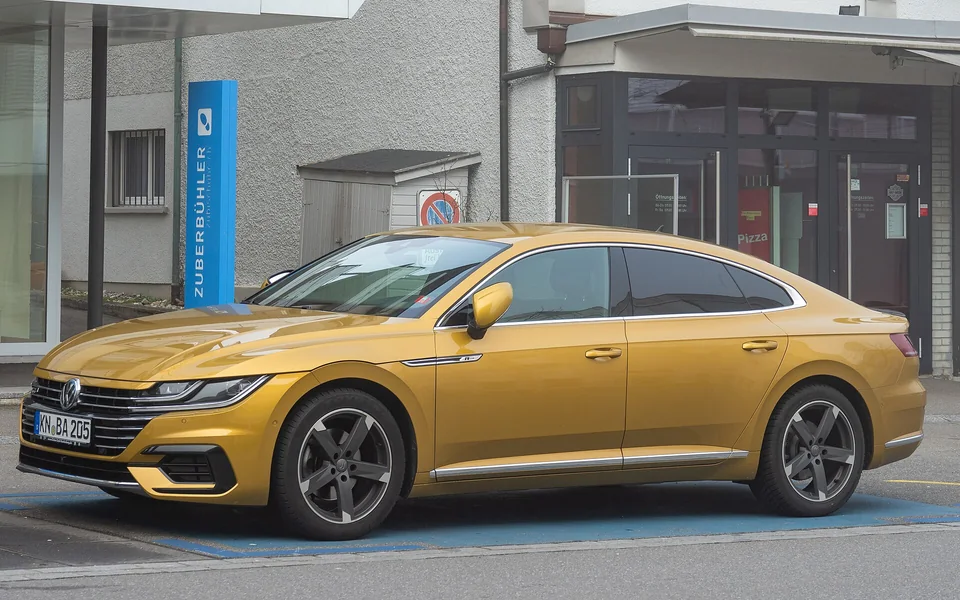
Volkswagen Arteon
Why 8.6: A five-metre fastback with a frameless-window profile, a liftback boot and a full-width light bar, built on the same MQB architecture as a Golf and sold at Passat money. Volkswagen designed a flagship and then priced it like a family car, which is precisely why nobody read it as one.
Layout
Natural habitat
Ride comfort
Sound
Volkswagen gave the R-Line a freer exhaust and the EA888 does find a hard metallic edge under boost that no Arteon diesel manages. But this is a 2.0 four in a five-metre fastback tuned for autobahn quiet, and much of the induction noise arrives through a Soundaktor on the bulkhead. Piped, and not enthusiastically.
4-cylinder · turbocharged · 6,500 rpm redline · rated 3.4 / 10 for engine sound
Market value
Median asking price, good condition · €42k (2019) → €20k (2026), trending down · illustrative data
Child seats · ISOFIX
Two ISOFIX positions on the outer rear seats, the outer pair being the ones the standard covers.
The rear anchors are the supported route — the manual points child seats there, and front-passenger ISOFIX is the exception rather than the rule. A belt-mounted seat up front needs the airbag off, and cars with a rear row don't always fit a deactivation switch, precisely because the rear seats exist.
Derived from production years and seating layout, not a per-car source. ISOFIX was standardised as ISO 13216 in 1997, required on new EU model types from 2011 and on all new EU cars from 2014.
The long version
The Arteon replaced the CC and was meant to be the car that let Volkswagen charge Audi prices without an Audi badge — a swooping four-door coupe with a genuinely striking nose, adaptive dampers, and an interior a class above the Passat it was based on. It never worked commercially. Buyers who wanted the look bought an A5 Sportback, buyers who wanted the space bought a Passat estate for twenty per cent less, and Volkswagen quietly wound the model down without a successor. What that produced is one of the purest cases the index measures. There is no Arteon collector market, there never will be, and the depreciation curve is close to vertical: a car that stickered around £40,000 in Britain and $46,000 in America can be had for a quarter of that today. Every single one of them is therefore in the hands of someone who wanted a large, comfortable, quiet motorway car and worked out that this was the most of it per pound available. They cover enormous distances — the European diesels especially, which routinely show six figures inside five years — and the practical liftback boot means most are doing family and business duty rather than sitting. Nobody stores an Arteon. Nobody has ever tried.