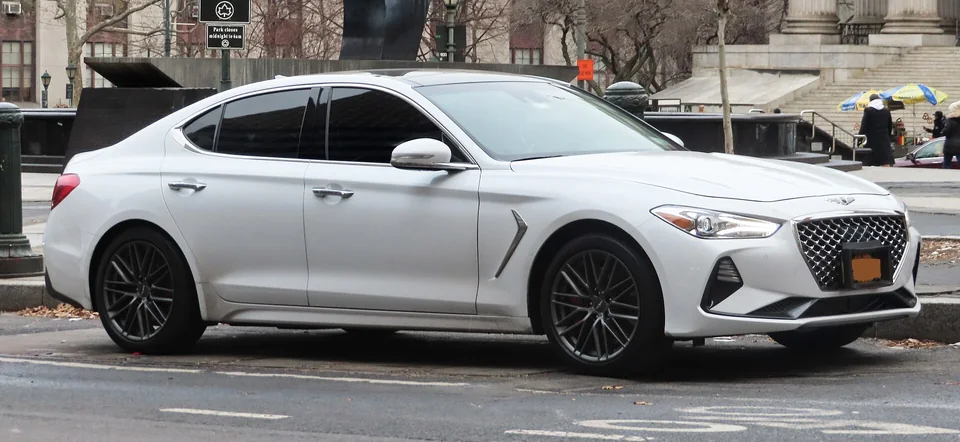
Genesis G70 3.3T
Why 8.1: A short-wheelbase rear-drive saloon with 365 hp, Brembo brakes and a chassis signed off by Albert Biermann, who had just spent thirty years at BMW M. For two model years in America it was also available with a six-speed manual, which is more than BMW offered in the same showroom window.
Layout
Natural habitat
Ride comfort
Sound
The Lambda twin-turbo six shoves with real depth and the Sport's exhaust valve opens into a genuine overrun crack — Hyundai went looking for this deliberately. But it is a 60-degree V6 behind two turbos and a lot of firewall insulation, and it signs off at 6,500 rpm. Convincing rather than stirring.
6-cylinder · turbocharged · 6,500 rpm redline · rated 5.6 / 10 for engine sound
Market value
Median asking price, good condition · €41k (2019) → €23k (2026), trending down · illustrative data
Child seats · ISOFIX
Two ISOFIX positions on the outer rear seats, the outer pair being the ones the standard covers.
The rear anchors are the supported route — the manual points child seats there, and front-passenger ISOFIX is the exception rather than the rule. A belt-mounted seat up front needs the airbag off, and cars with a rear row don't always fit a deactivation switch, precisely because the rear seats exist.
Derived from production years and seating layout, not a per-car source. ISOFIX was standardised as ISO 13216 in 1997, required on new EU model types from 2011 and on all new EU cars from 2014.
The long version
The G70 shares its rear-drive platform with the Kia Stinger and arrived in 2017 as the sharp end of Hyundai's luxury experiment. Almost every review said the same two things: that it drove better than it had any right to, and that nobody would buy it because of the badge on the bonnet. Both turned out to be true. Genesis sold a few thousand a year in America against six-figure volumes for the German compact saloons, and the consequence was a discount culture from day one — heavy incentives, aggressive leases, and residual values that fell faster than the class average because the used market had no idea what the car was. That collapse is what makes it interesting now. A 3.3T Sport that stickered near $50,000 with options trades in the low twenties, which is Civic money for a rear-drive twin-turbo six with adaptive dampers and a five-year warranty attached to the drivetrain. Nobody is putting one away: there is no Genesis auction market, the manual cars are too few and too recent to have found a collector narrative, and the enthusiasts who did buy them bought them precisely because they were cheap to run and quick. High mileage, no speculation, and the quiet satisfaction of having been right before the market was.