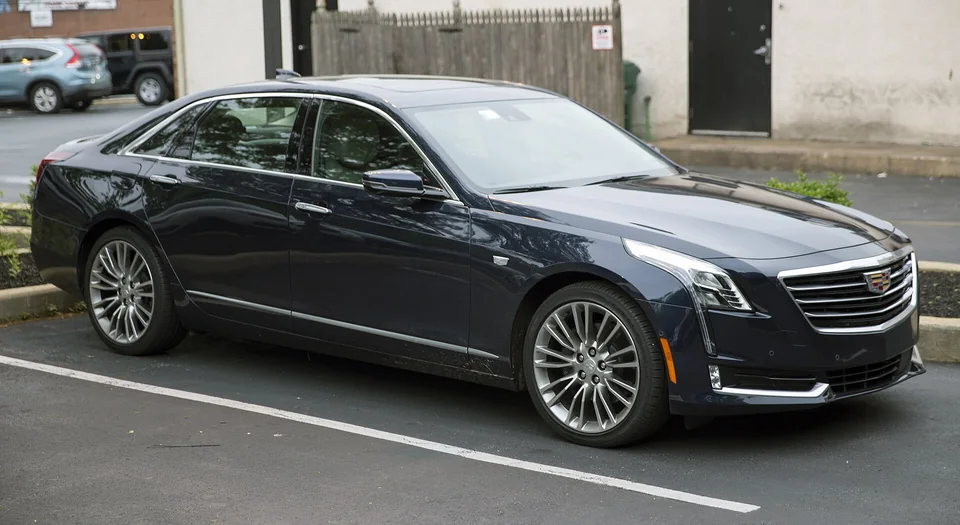
Cadillac CT6
Why 7.9: A full-size rear-drive-based saloon with an aluminium-intensive body that came in lighter than a 5 Series, active rear-wheel steering, and the first version of Super Cruise — genuinely hands-off motorway driving two years before anyone else offered it.
Layout
Natural habitat
Ride comfort
Sound
The LGX 3.6 is a smooth direct-injection six that will spin cleanly to 6,800 rpm with nothing boosted in the way. But Cadillac's whole target for the CT6 was library quiet — Bose cancellation, laminated glass, an aluminium structure tuned for isolation — and the eight-speed short-shifts long before any of it reaches you.
6-cylinder · naturally aspirated · 6,800 rpm redline · rated 3.8 / 10 for engine sound
Market value
Median asking price, good condition · €66k (2018) → €24k (2026), trending down · illustrative data
Child seats · ISOFIX
Two ISOFIX positions on the outer rear seats, the outer pair being the ones the standard covers.
The rear anchors are the supported route — the manual points child seats there, and front-passenger ISOFIX is the exception rather than the rule. A belt-mounted seat up front needs the airbag off, and cars with a rear row don't always fit a deactivation switch, precisely because the rear seats exist.
Derived from production years and seating layout, not a per-car source. ISOFIX was standardised as ISO 13216 in 1997, required on new EU model types from 2011 and on all new EU cars from 2014.
The long version
The CT6 was Cadillac's proper attempt at a German flagship and by most engineering measures it succeeded. The body mixes aluminium castings, extrusions and stampings with steel only where it earns its place, which is why a car nearly as long as an S-Class weighs about the same as a mid-size BMW; the rear-steer system makes it shrink in town; and Super Cruise, launched on this car in 2017, is still the benchmark against which hands-off systems are judged. What killed it had nothing to do with any of that. General Motors decided to close Detroit-Hamtramck to retool it for electric trucks, and the CT6 was built at Detroit-Hamtramck. It ended in 2020 with no successor and Cadillac has not sold a full-size saloon since. For an index that measures what happens to a car after the showroom, a discontinued flagship from a brand with no flagship market is close to a controlled experiment. The depreciation is brutal and complete — a $72,000 car is a $26,000 car — and there is not a single speculator anywhere in the market, because there is no version of the future in which a 3.6-litre CT6 is worth money. The people who own them now bought a very comfortable, very quiet, aluminium-bodied American saloon for the price of a used crossover, and they use it exactly as intended. The V-Sport and the 550 hp Blackwing-engined CT6-V are a separate, much rarer story.